
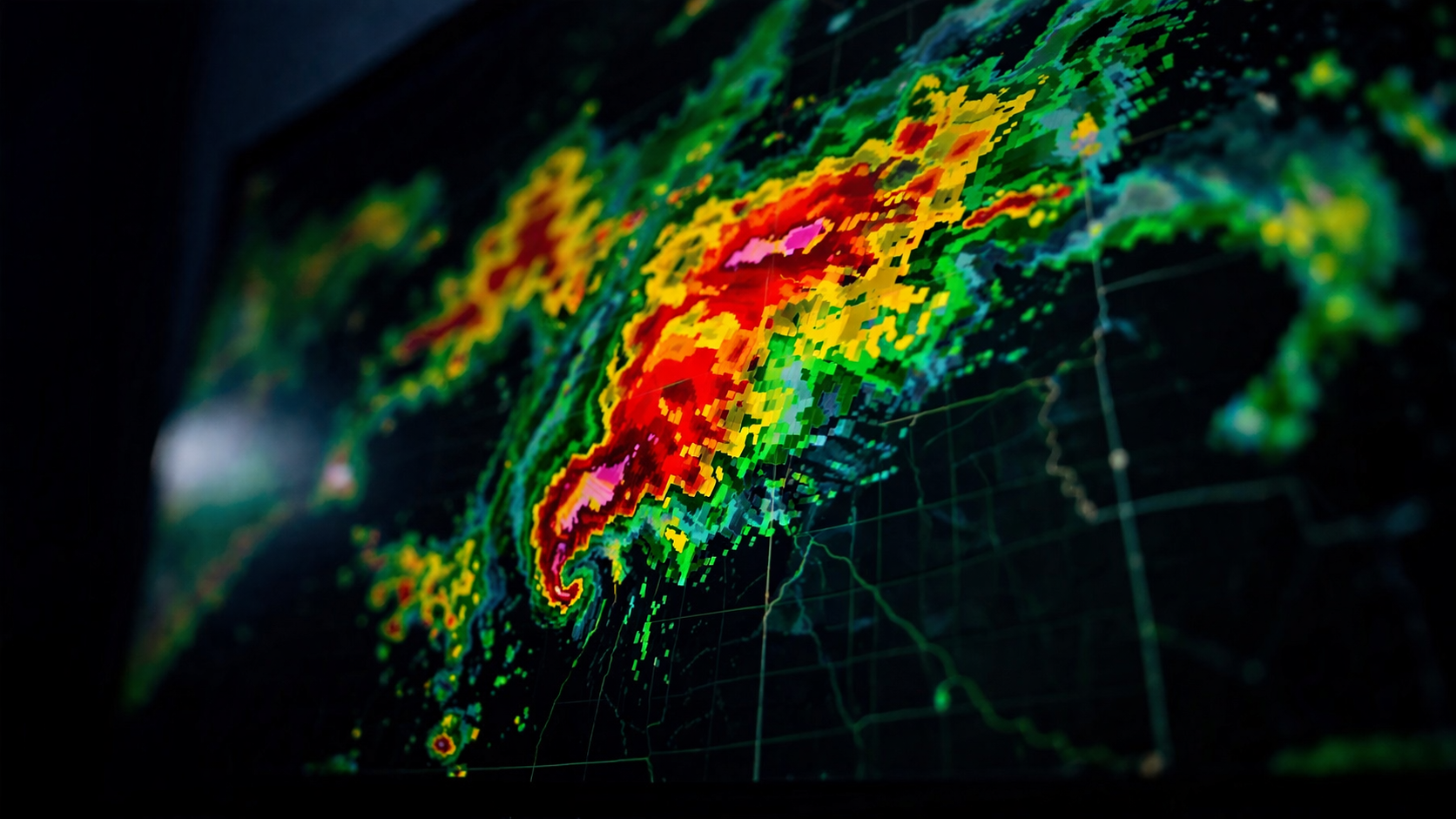
Independent meteorologists and weather bloggers occupy a unique space in the weather world. You combine professional-grade knowledge with a direct relationship with your local audience — the kind of relationship that national weather platforms can never replicate. Your community trusts your analysis, your forecasts, and your storm coverage because they know you understand their area in a way that a national app never will.
But to deliver on that trust, you need two things: the right tools for your own radar analysis, and a way to share live radar directly on your website — so your audience stays with you during severe weather events instead of scattering to third-party platforms.
Here is a breakdown of the best radar for meteorologists and weather bloggers in 2026.
Radar for Meteorologists: Personal Analysis Tools
These tools are built for meteorologists who need deep, professional-grade radar data for their own analysis and forecasting work.
RadarScope — Professional Doppler Radar Analysis
RadarScope is widely regarded as the go-to radar analysis tool among professional and semi-professional meteorologists. It provides access to full-resolution Level 2 and Level 3 NEXRAD data, dual-polarization products, and professional-grade storm analysis features. Meteorologists use it to analyze storm structure, identify rotation signatures, and assess severe weather threats in real time.
RadarScope is available on iOS, Android, macOS, and Windows. The base app is a one-time purchase — $9.99 on iOS and Android, and $29.99 on macOS and Windows. Optional Pro subscriptions add features like real-time lightning, extended radar loops, dual-pane display, and shear contours for rotation detection. Pro Tier 1 costs $9.99 per year and Pro Tier 2 costs $99.99 per year. RadarScope is a powerful personal analysis tool but is not designed for embedding radar on a third-party website — it is a tool for the meteorologist, not for sharing live radar with an audience.
WeatherTAP — Comprehensive Professional Weather Data
WeatherTAP is a professional weather data platform that provides access to thousands of radar products, satellite imagery, model data, and weather maps — all ad-free. It is used by meteorologists, first responders, pilots, and emergency managers who need comprehensive, real-time weather data without distractions.
WeatherTAP offers Level II radar updated approximately every 5 minutes, with updates available within 1-2 minutes under active severe weather conditions using SAILS and MRLE cuts. It also provides dual-pane and quad-pane workspaces for viewing multiple products simultaneously, and storm tracking tools including custom locations and severe weather alerts. Plans start at $9.95 per month.
Like RadarScope, WeatherTAP is a personal analysis platform — it is not designed for embedding radar on a weather website or blog.
For Your Weather Website or Blog
These tools are built for sharing live radar with your audience — keeping them on your platform during severe weather events.
ZoomRadar — Live Embeddable Radar for Weather Websites
ZoomRadar is purpose-built for meteorologists who run their own weather websites and want to give their audience a professional-grade live radar experience. According to ZoomRadar’s own website, meteorologists with dedicated weather sites are one of their primary customer segments — and it is easy to see why.
ZoomRadar delivers Level 2 Doppler radar data from NOAA NEXRAD stations across the US, updating every 4–5 minutes. The radar map is fully customizable — you can zoom it to your specific coverage area, add your logo, and enable the overlays that matter most to your audience, including storm tracks, warnings, lightning, temperatures, winds, and real-time tornado detection on the $60/month plan.
Embedding is straightforward — paste a custom map URL into your website’s HTML editor and the live radar appears on your page. Plans start at $12 per month with publicly listed pricing. No developer required for most website platforms.
For an independent meteorologist, this means your audience gets live, professional-grade radar directly on your site — not a link to Weather.com or a consumer app. Your brand, your map, your community.
The Two-Tool Approach
The most effective setup for an independent meteorologist or weather blogger combines both types of tools. Use RadarScope or WeatherTAP for your own deep radar analysis and forecast preparation. Use ZoomRadar to embed a live radar map on your website so your audience has real-time storm tracking available directly on your platform.
This way, you maintain the professional-grade analysis capability you need behind the scenes, while your audience gets a seamless live radar experience that keeps them engaged with your content — especially during active severe weather when traffic to weather sites spikes dramatically.
Choosing the Right Setup for Your Site
RadarScope and WeatherTAP are excellent for what they do — deep personal analysis, storm structure examination, and forecast preparation. If that is your primary need, either will serve you well.
But your audience does not use those tools. They use your website. And when severe weather strikes your coverage area, the question is whether your website can deliver live radar to the people who depend on you — or whether it sends them somewhere else to find it. For that specific job, ZoomRadar is the only tool built specifically for independent meteorologists and weather bloggers. Your analysis stays yours. Your audience stays with you.
Frequently Asked Questions
What is the best radar tool for independent meteorologists?
For personal analysis and forecast preparation, RadarScope and WeatherTAP are the leading tools used by independent meteorologists — providing full-resolution Level 2 NEXRAD data, dual-polarization products, and professional storm analysis features. For sharing live radar with a website audience, ZoomRadar is the only platform built specifically for embedding professional-grade radar on a meteorologist’s own website.
What is the difference between RadarScope and ZoomRadar?
RadarScope is a personal radar analysis tool — it is built for the meteorologist to analyze storm structure, rotation signatures, and severe weather threats. ZoomRadar is a website embed tool — it delivers live Level 2 Doppler radar directly on your website so your audience can track storms in real time without leaving your platform. They serve different purposes and work best used together.
Can I embed RadarScope or WeatherTAP on my weather website?
No. RadarScope and WeatherTAP are personal analysis platforms designed for individual use — neither offers an embeddable radar map for third-party websites. ZoomRadar is the only tool on this list specifically built to embed live professional-grade radar on a weather website or blog.
How does ZoomRadar work for meteorologist websites?
After subscribing, you provide ZoomRadar with your coverage area and customization preferences. ZoomRadar configures a custom radar map within 1–2 days and provides a URL you paste into your website’s HTML editor. The live Level 2 Doppler radar appears on your page immediately — branded with your logo, centered on your coverage area, updating every 4–5 minutes.
How much does it cost to add live radar to a weather website?
ZoomRadar plans start at $12 per month for a sidebar radar widget with publicly listed pricing. The $60 per month plan adds real-time tornado detection with a 90% average detection rate for EF2+ tornadoes — a key feature for meteorologists covering tornado-prone areas.
Do I need a developer to embed radar on my weather blog?
No. ZoomRadar embeds via a single URL paste into your website’s HTML editor. It works on WordPress, Squarespace, Wix, and most other platforms without any coding or developer involvement.
Ready to Add Live Radar to Your Website?
See how easy it is to embed professional-grade weather radar on your site. No sales process, setup in days.